


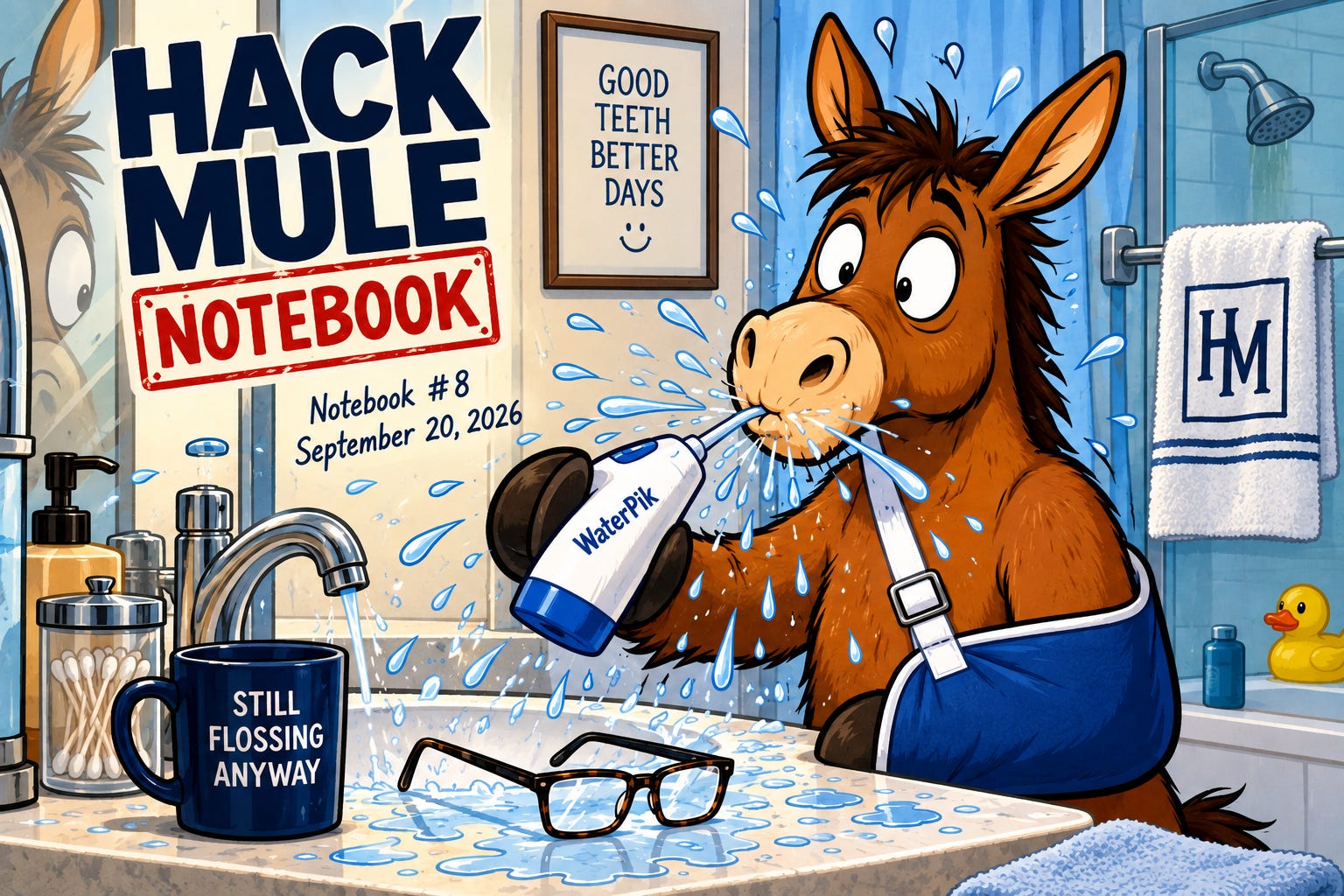
Welcome to Hack Mule Notebook #8! It’s been a busy week here at the Hack Mule barn, but despite last week’s injury, I’m up and around just fine. So dig in, enjoy, and for something a little meatier, stick around until the review at the end of the issue.
And special thanks to all of you who reached out to check on me. I appreciate the good wishes and the offers of help. I have quite a few more weeks of recovery ahead, so I may well take you up on them!
Overheard
Two men in suits and TV makeup having coffee:
First Guy: “Josh Shapiro would be a good president, but he can’t win. You can tell by looking at him that he knows it. His whole face radiates, ‘I can’t win, and I know it.’”
Second Guy: “That’s just what he wants you to think.”
— at Starbucks, Wisconsin Avenue, Bethesda
Elevator Follies
I got on the elevator the other day with my broken arm in a sling. Adele, one of the Leviathan’s self-appointed gossip-distribution managers, looked me up and down and scowled.
“What is going on here?” she asked.
I knew damn well what she meant, but I thought I’d make her work for it: “Good morning, Adele. How are you?”
“What exactly is wrong with your arm?”
“This? Oh. I broke it the other day.”
“I didn’t know about this.”
“Oh. Well, that’s the whole story. Broke it.”
“I was not informed,” she said. “I had not heard that you had broken your arm.”
I wanted to say, “Why would you have heard?” but I didn’t bother. Instead, I decided to drive her insane.
“Really? I thought I’d told everyone. I even wrote about it on the internet.”
“I was not informed!” She glared like I was a junior associate who had ignored a major account. “And people don’t see you. You are not around.”
“I live here,” I said. “I’m here every day.”
“Well, you’re not on the elevator at the normal times,” she sniffed as she exited. “And I was not informed. I expect to be informed.”
I hope this doesn’t go on my permanent record.
Gadgets
As I mentioned last week, after I broke my arm, my dentist told me to get a WaterPik since I can’t floss one-handed. I found the WaterPik Water Flosser 3100, a portable, rechargeable, and—most importantly—inexpensive model.
Plus, the name makes it sound like something Harry Potter would use as a jet ski.
The description on Amazon seemed promising, noting that it has the American Dental Association Seal of Approval and a two-year warranty. Good enough.
But as I read on, I started to wonder exactly how people use it. Amazon says it “can be used in the shower,” adding, “the manual’s warnings apply ONLY if the symbol displays on the product labels & packaging. The ‘Do not use this device in a shower’ symbol is not on this item’s labels or packaging and does not apply.”
What are they talking about? Why would anyone use it in the shower?
I would soon find out.
I’m not sure what I was expecting when I filled it up, aimed it toward my face, and flipped the switch, but the world’s tiniest fire hose suddenly knocked off my glasses.
Momentarily blinded, I swung the WaterPik around as I groped for the glasses, soaking the bathroom. The walls appeared to be crying.
Dripping and defeated, I went to find extra paper towels and a squeegee.
Once I got things dried off, I decided to reload and try again. This time I got smart and put it in my mouth before I turned it on.
Nowhere do the instructions say, “Let the water dribble out of your mouth,” but they should, because otherwise it’s like aiming a SuperSoaker down your windpipe. Visions of an obituary announcing that I’d drowned in an unfortunate WaterPik accident flashed before my eyes as I choked and sputtered.
But maybe the third time’s the charm. I refilled once more. I leaned over the sink, put the WaterPik in my mouth, aimed it at my teeth, and turned it on.
Had my dentist not recommended this thing, I’d have assumed that I’d made a horrible mistake. Not only does the Water Flosser 3100 “floss” between your teeth, its “PrecisionPulse technology” power washes your entire mouth, scouring your gums for the 45 seconds it takes to empty the water chamber.
Hurts like hell—and I was already on painkillers.
But it works really well. Now, every night, I get into the shower and blast away. It’s all clear to me now.
Listening
Even in weird weeks, music seeps through around the edges. You can enjoy the full Hack Mule playlist on Apple Music. Here is the soundtrack that followed me around last week:
“Get What I Want,” Bitter:Sweet—getting some steps in the Leviathan
“Dracula,” Tame Impala—earworm transmitted by a friend
“Goodbye Yellow Brick Road,” Elton John—at the orthopedic surgeon’s office
“The Rebirth of Fat Lola,” Club des Belugas—at Whole Foods, North Bethesda
“Whip It,” Devo—riding the bus, Old Georgetown Road
“Keeping Our Heads Above Water,” The Jayhawks—at Starbucks, Bethesda
“Rumor Has It,” Adele—at the salon where I emerge with a great haircut and low-grade depression due to all the Adele
“The Beachcomber,” Vulfpeck—waiting at Bethesda Metro
“Easy Skanking,” Bob Marley—at Filicori Zecchini, Potomac
“Blue World,” Chenayder—working at my desk
Milestones
Reappeared: Mallomars made their annual fall return to grocery shelves this week. Some of us may have made the pilgrimage to our local stores, despite great pain and effort. (Well, sort of. I found them in the inconvenience store in my building. But my arm did hurt while I was there.)
Mallomars are only in stores from September to March each year. When Nabisco first released them 113 years ago, before the advent of refrigerated trucks, the company worried that the dark chocolate shells covering cloud-like marshmallow puffs would melt during transit, so they sold them only during cooler months.
Awaiting the annual return of the Mallomar—basically the East Coast’s answer to the swallows returning to San Juan Capistrano—became such a tradition that Nabisco kept up the schedule, despite technology that could preserve them year-round.
Many people don’t know the history behind the cookies. Mallomars were invented by Paul Malleaux and James Mars as a special treat at the White House during Woodrow Wilson’s inaugural ball. Wilson liked them so much that he signed an Executive Order making the “Mallomar”—a portmanteau of the inventors’ names—the official cookie of the Democratic Party.
Malleaux and Mars later sold the recipe to Nabisco.
Note: Certain facts presented in Hack Mule may not, in fact, be factual. Fact is, they may not even be facts. Any resemblance to actual facts, living or dead, is purely coincidental. Use only as directed.
Watching:
Famous Last Words: Gloria Steinem (Netflix)
This show has an irresistible premise: Activist and editor Gloria Steinem sat down for a 45-minute interview in February 2025, with the understanding that it would not be released until after her death. She and interviewer/executive producer Brad Falchuk sat alone on a pre-lit stage. Even the people operating the cameras remotely couldn’t hear what they were saying.
Two weeks after her death, Netflix has released the interview.
A secret in-depth interview in anticipation of death? That ought to create some interesting possibilities. Instead, much of the interview felt like Falchuk was pressing buttons on a Gloria Steinem jukebox. Hit B26 and out comes Betty Friedan. D14 is Clay Felker. “Let’s play Wilma Mankiller one more time.” And so on.
To be fair, Steinem sat for countless interviews for more than half a century. Maybe a “greatest hits” jukebox is all she would play. She had decades to decide what parts of herself are public and how she wants to talk about them.
But then why agree to a show with this premise? Every once in a while, Steinem says something that sounds like an opening—a glimmer of revelation that might put her decades of work and commentary into perspective. Something that might offer an insight or clue.
But Falchuk doesn’t walk through the door.
Talking about her difficult childhood, for example, Steinem says that her mother “became addicted to what was an early tranquilizer, sodium pentothal,” and she was “regarded as the crazy lady in the neighborhood—it was just she was somebody to be cared for.”
Wait. How did Steinem know that? Did she witness the drug-taking? Did the other children say something? Was she embarrassed by her mother? Did she ever wish she had a different mother? How did being the daughter of “the crazy lady” shape the person she became?
Falchuk follows up with, “Right.”
I mean, bravo for letting her talk, but seed the clouds a little.
Oddly, he’s more willing to venture into Steinem’s sex life, at one point asking very personal questions about a boyfriend she slept with in college. She answers openly, but she seems slightly uncomfortable—suddenly you see a 90-something woman raised in an era when people were more discreet, not a revolutionary firebrand.
So, Falchuk is willing to make her uncomfortable personally, but I’m not sure he ever makes her uncomfortable intellectually.
That seems like a missed opportunity in an interview called Famous Last Words. If you’re going to interview someone at 90 and deliberately withhold the conversation until after she dies, why cover so much ground she has discussed before?
Steinem does occasionally produce a wonderful line. “I was scared, but I wasn’t crying,” she says at one point. “Because crying connotes a solution.” Later: “I don’t know if we can contemplate our own nonexistence.”
But I wanted Falchuk to ask the questions that only make sense at the end of a very long and consequential life.
You’ve lived for almost a century. How is the world different because of you?
What did you not accomplish?
Or, more simply: Gloria, you’re 90. Where did you fail?
She might have dodged every one of those questions. That would have been interesting, too.
But if you’ve built an entire television format around getting someone’s last words, stop pressing B26.