


Artist Jean-Michel Basquiat is having quite a moment this fall. This week, Sotheby’s estimated that his 1982 painting Crowns (Peso Neto) could fetch up to $45 million at auction in November.
Basquiat also led the sales at Phillips last week, when his Pestus accounted for $3.9 million of the auction house’s $13.9 million in sales. His work attracted strong prices last spring as well, despite a sluggish art market overall.
Not bad for a graffiti artist who’s been dead for 37 years.
He’s making the scene with art institutions, too. In a final act before closing its doors for the federal shutdown, the Hirshhorn announced that it is extending its small — and hugely successful — Basquiat x Banksy exhibition through January 2026.
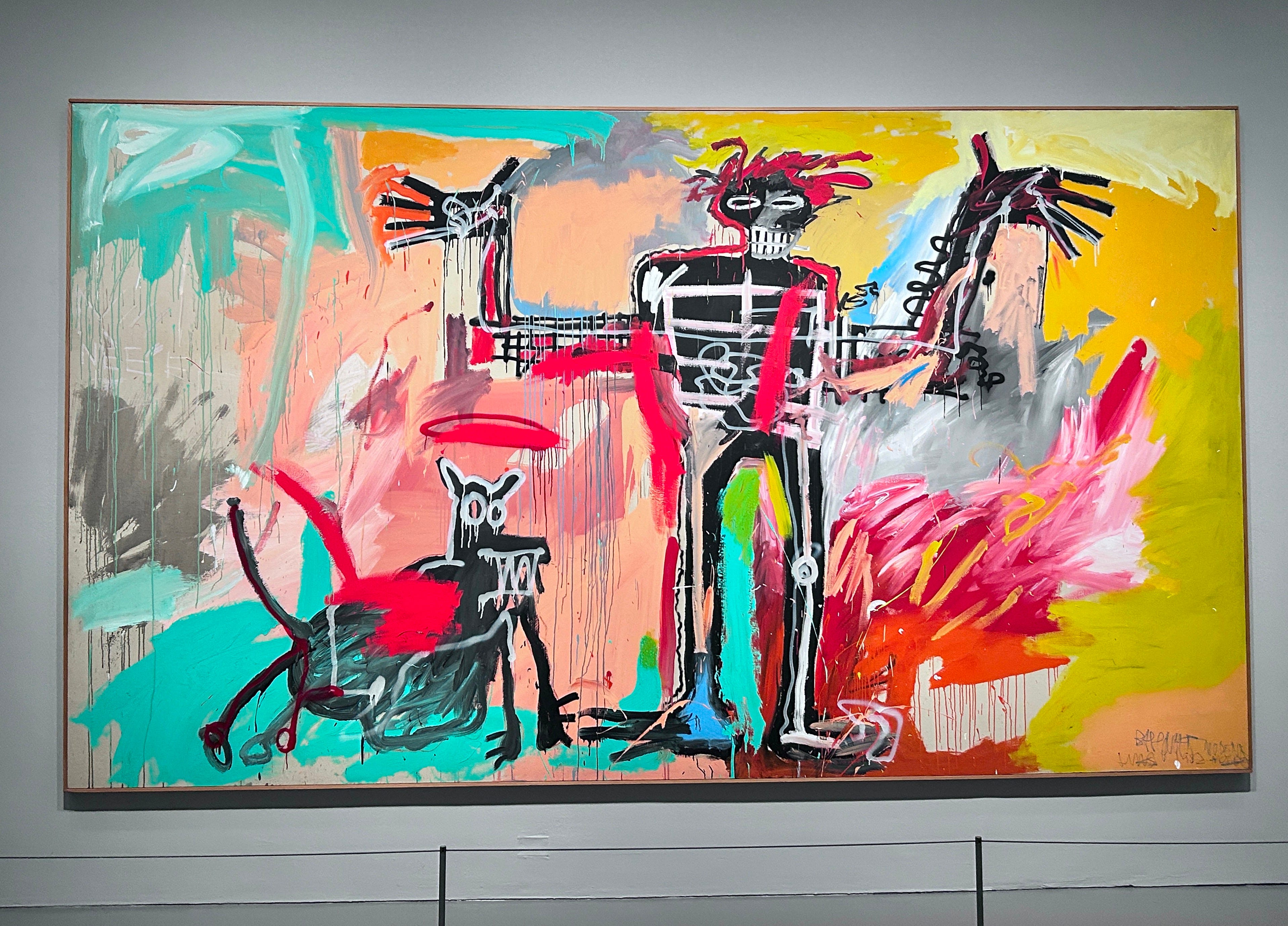
I stopped by the Hirshhorn to have a look just before it shut down in early October. It’s a very small, bare-bones show — about 20 pieces tucked in the basement.
The Hirshhorn says it’s going for a “dialogue” here, placing Basquiat’s Boy and Dog in a Johnnypump (1982) and Banksy’s Banksquiat. Boy and Dog in Stop and Search (2018) adjacent to each other in a nearly empty room.
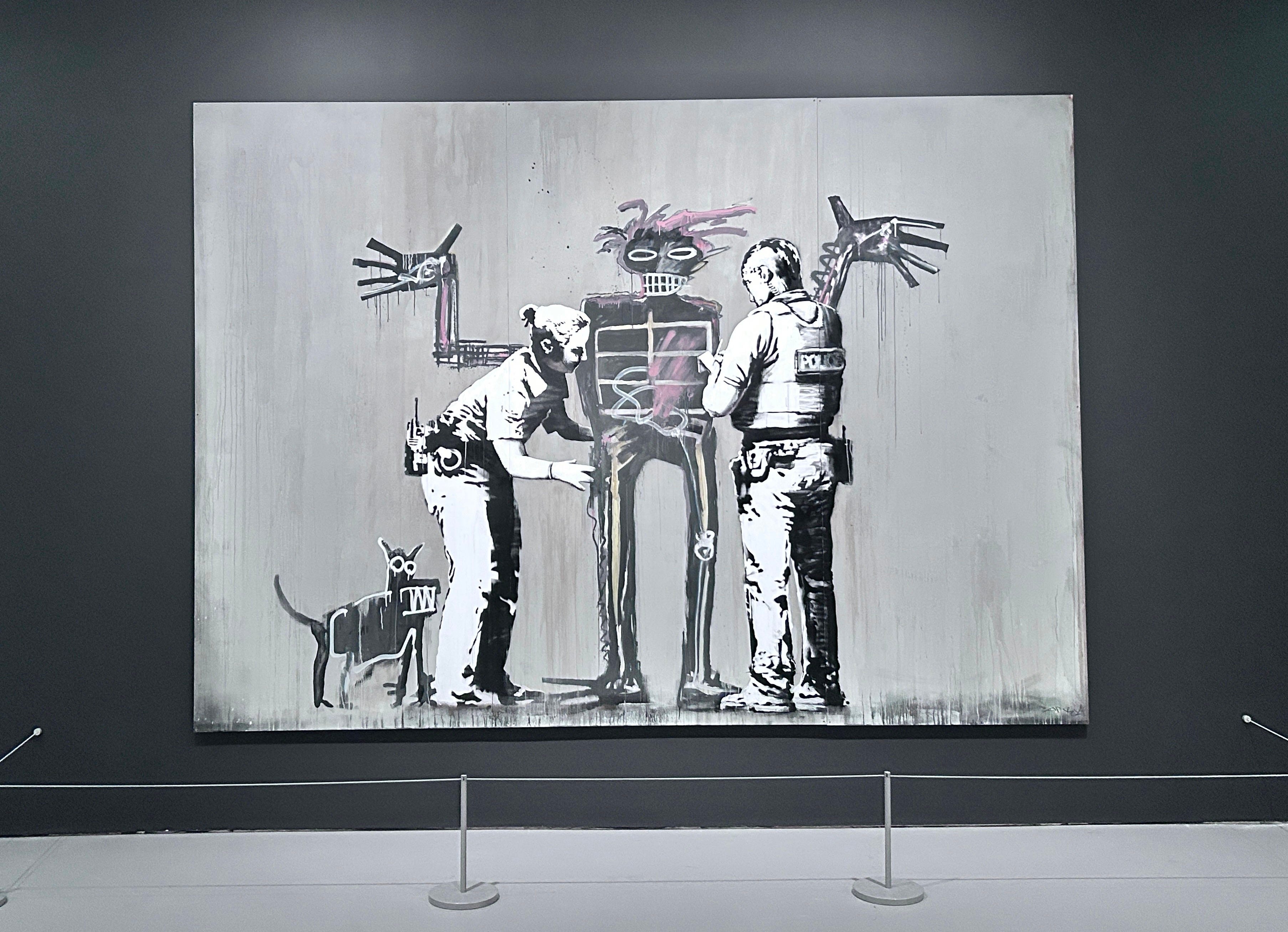
The Banksy piece certainly echoes the Basquiat, but it’s not clear what they’re saying to each other in this “dialogue” — maybe a whispered, “How did we end up here?” And the Hirshhorn’s curation didn’t help, since its message seemed to be: “Check this out: two street artists with similar paintings, and we’ve got them in captivity for you to see!”
It’s a curious approach to take, since Basquiat aimed for communications control, not dialogue, in his work. He even frequently incorporated words into his paintings, then crossed them out to make the viewer look harder — to force attention, not invite discussion.
Banksy is similarly direct. When London’s Barbican Centre held a Basquiat retrospective in 2017, Banksy graffitied the building’s walls with designs “quoting” Basquiat’s style. Just to underscore the point, he wrote:
“Major new Basquiat show opens at the Barbican. A place that is normally very keen to clean any graffiti from its walls.”
Banksy was almost appointing himself Basquiat’s spokesman — one street artist defending another street artist from being curated to death.
No matter. The Barbican responded with its own statement by installing Plexiglas over the Banksy’s mockery, institutionalizing the outsider. This “catch-and-release” approach effectively turned their one-man Basquiat exhibition into a two-man show with graffiti under glass.
The Hirshhorn has its own ironic, slightly tone-deaf moment. When visitors enter the exhibition, the first room is dedicated to a single video monitor playing the film, “Downtown 81,” on a loop.
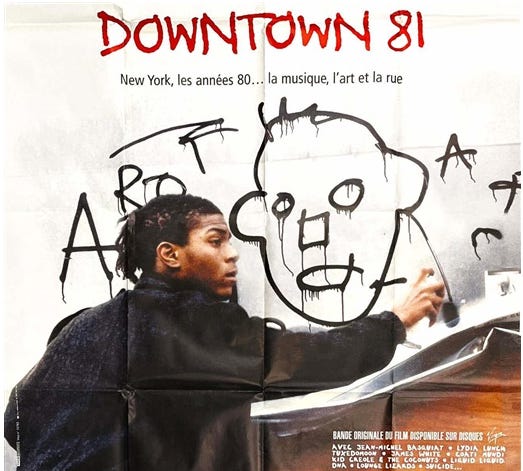
The film follows the character “Jean-Michel” — played by 21-year-old Basquiat — drifting through the New York early-80s art scene. But, here’s the funny part: the film’s soundtrack was destroyed, so the movie that attempts to give voice to this young artist literally had to dub someone speaking for him.
But, that’s OK. Film, like visual art, can speak for itself.
The Hirshhorn show did make me wonder, though, what Basquiat would be painting — and how he’d be communicating — today. By 1981, the art world recognized his work, and he was well on his way to becoming the man the Hirshhorn describes as “one of the most important artists of the 20th century.”
But would he have looked for new ways to express his thoughts? Street kids today have phones where they can shoot cinematic video in surround sound and that they post it to social media in the moment. Do they have the same urge to communicate through painting? Will TikToks have the same impact as a $45 million Basquiat does?
Let me know what you think — I am always interested in a dialogue. And, if you’re in Washington after the government reopens, go have a look at the Hirshhorn’s Basquiat x Banksy exhibition before it closes. See if it speaks to you.